
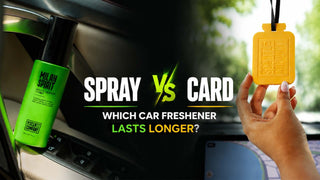
It’s the simplest question in car fragrance, and the one UK drivers ask most often: should I buy a car air freshener spray or a hanging card? Both are affordable. Both are available everywhere. Both promise to keep your car smelling fresh. But they work in completely different ways, and when you compare them on the metrics that actually matter, how long the scent lasts, how much each day of freshness costs, and which one performs better in real UK driving conditions, the gap between these two formats is far bigger than most people expect.
We’ve tested car air freshener sprays and hanging cards side by side in real UK conditions to settle this comparison once and for all. This guide gives you the numbers, the experience, and an honest verdict. No vague claims, just facts UK drivers can use to make the right choice.
How Each Format Actually Works
Car Air Freshener Spray
A car air freshener spray is a pump-operated bottle containing concentrated fragrance. You press the nozzle, a fine mist disperses into the cabin, and the scent settles onto fabric surfaces, seats, carpets, and headlining, where fragrance molecules bind and release slowly for one to three days. You decide when to spray, how much to spray, and how strong you want the scent. Premium sprays like the Scentz 30ml Mist Spray deliver up to 150 individual applications per bottle.
Hanging Card Air Freshener
A hanging card is a flat piece of material, either absorbent cardboard (traditional trees) or EVA polymer (modern poly cards) soaked in fragrance oil. You hang it from your rear-view mirror, and the scent evaporates passively into the cabin air. There’s no control over intensity: the card releases whatever it releases, strongest at the start and fading steadily over its lifespan. Cardboard trees typically last one to three weeks. Premium scented poly cards last two to four weeks because the EVA polymer holds oil more effectively.
Spray vs Card: The Full Head-to-Head Comparison
Here is every meaningful metric compared between a car air freshener spray and a hanging card, based on real UK products and testing conditions.
|
Feature |
Car Air Freshener Spray |
Hanging Card (Poly Card) |
|
UK Price |
£5.99 for 30ml |
£2.99 per card |
|
Uses Per Purchase |
Up to 150 sprays |
1 (single card) |
|
Total Product Lifespan |
3–6 months |
2–4 weeks |
|
Scent Per Application |
1–3 days per spray |
Continuous, steadier fade |
|
Cost Per Day |
~4p |
11–21p |
|
Scent Quality |
Multi-layered (top, heart, base notes) |
Moderate, more consistent |
|
Scent Intensity Control |
Full 1 to 3 sprays your choice |
None fixed by card |
|
Works with Engine Off? |
Yes scent bonds to fabrics |
Yes passive evaporation |
|
Multi-Use Beyond Car? |
Yes room spray, wardrobe, gym bag |
Wardrobe, drawers |
|
Visual Impact |
Hidden (glove box) |
Visible hanging from mirror |
|
Residue Risk |
Minimal fine mist evaporates |
None |
|
UK Climate Performance |
Consistent year-round |
More consistent than cardboard |
|
Best For |
Daily drivers wanting control + value |
Budget entry into premium scent |
The Longevity Question: How Much Longer Does a Spray Actually Last?
This is the core question behind the car air freshener spray vs card comparison, and the numbers are not close.
A standard cardboard tree hanging card delivers noticeable scent for about seven to fourteen days in typical UK conditions. After that, the fragrance oil has largely evaporated and what remains is a faint, flat echo of the original scent. Premium poly cards last longer, fourteen to twenty-eight days, because the EVA polymer releases oil more slowly than cardboard. But even the best card is a single-use product that ends up in the bin after a few weeks.
A 30ml car air freshener spray delivers a completely different experience. Each pump application creates a fresh burst of scent that lasts one to three days. With up to 150 sprays in the bottle, one purchase gives you anywhere from three to six months of daily freshness. That’s roughly ten to fifteen times the lifespan of a single hanging card from a single purchase.
In real terms: to match the longevity of one £5.99 spray bottle, you’d need to buy and replace 10 to 15 hanging cards. At £2 per card, that’s £20 to £30 worth of cards to match what one spray bottle delivers. The car air freshener spray doesn’t just last longer it costs less to deliver the same number of fresh-scent days.
The Real Cost: Spray vs Card Over 6 Months
|
|
Spray (30ml) |
Poly Card |
|
Unit price |
£5.99 |
£2.99 |
|
Lifespan per unit |
3–6 months |
~3 weeks |
|
Units for 6 months |
1–2 |
8–9 |
|
Total 6-month cost |
£5.99–£11.98 |
£23.92–£26.91 |
|
Cost per day |
~4p |
~13–15p |
A car air freshener spray costs £6 to £12 for six months. Poly cards cost £24 to £27. The spray wins on value by a significant margin, and that’s before factoring in the spray’s superior scent quality and intensity control.
Scent Quality: Where the Difference Is Most Obvious
Price and longevity aside, the single biggest experiential difference between a car air freshener spray and a hanging card is scent quality. This is the factor that converts card users into spray users permanently.
Hanging cards, especially cheap cardboard trees, typically deliver a one-dimensional fragrance. You get one note from the moment you open the packaging until the moment the scent dies. There’s no development, no complexity, no evolution. It smells the same on day one as it does on day ten, just weaker.
A well-formulated car air freshener spray delivers a completely different experience. Premium sprays use fragrance pyramids with distinct top notes (the first impression), heart notes (the main character that develops over 15 to 30 minutes), and base notes (the deeper scent that lingers for hours or days). The fragrance evolves as it settles onto fabrics and interacts with your cabin’s temperature.
For example, the Scentz Dubai Nights Mist Spray opens with rose and geranium, develops into oud and sandalwood, and settles into caramel and vanilla. That kind of layered scent journey is impossible with a flat, single-note card. Once you’ve experienced a multi-layered car air freshener spray, going back to cardboard trees feels like a significant downgrade.
When a Hanging Card Is Still the Right Choice
Despite the spray’s clear advantages, there are genuine situations where a hanging card makes more sense:
Testing a new scent. If you want to try a fragrance before committing to a full spray bottle, a £2.99 poly card is the lowest-risk way to experience a specific scent in your car for two to four weeks. The Scentz poly cards use the same fragrance formulations as the mist sprays, so the scent you experience on the card is exactly what you’ll get in the spray. It’s the perfect trial format.
Second cars and work vans. For vehicles you don’t drive daily, a hanging card provides set-and-forget freshness without requiring manual effort. A poly card sitting in a van you drive twice a week still releases scent passively between drives.
Gifts and stocking fillers. At £2.99, a scented poly card makes an easy, affordable add-on to gift bags and hampers. It’s a thoughtful touch that doesn’t require a big spend.
Budget-first buyers. If upfront cost is the only consideration, a £0.50 cardboard tree or a £2.99 poly card has a lower entry price than a £5.99 spray. But remember: per day of freshness, the spray is actually cheaper.
Final Verdict: Spray vs Card for UK Drivers
If you want the shortest possible answer: a car air freshener spray lasts longer, costs less per day, smells better, and gives you full control over intensity. A hanging card is cheaper upfront and requires zero effort, but it fades faster, delivers a flatter scent, and costs more over time.
For UK drivers who use their car daily, the spray is the clear winner. For drivers who want a budget trial, a one-off gift, or a low-effort option for a second vehicle, the poly card is a smart supporting choice.
The smartest approach? Start with a Scentz Poly Card at £2.99 to find your favourite scent, then upgrade to the Mist Spray at £5.99 for daily use. You get the best of both formats: the card’s simplicity for discovery, and the spray’s longevity and quality for everyday driving.
Shop Scentz Car Air Fresheners
Mist Sprays from £5.99 | Poly Cards from £2.99 | Hanging Diffusers from £5.99 | Beanbag Sachets from £4.99
Frequently Asked Questions
Does a car air freshener spray last longer than a hanging card?
Yes, significantly. A 30ml car air freshener spray delivers up to 150 applications over three to six months. A hanging card lasts one to four weeks as a single-use product. To match one spray bottle’s lifespan, you’d need to buy and replace 10 to 15 cards. The spray delivers roughly ten times more days of freshness from a single purchase.
Is a car air freshener spray cheaper than buying cards?
Yes, on a cost-per-day basis. A £5.99 spray works out to roughly 4p per day of freshness. A £2.99 poly card lasting three weeks costs about 14p per day. A £1.50 cardboard tree lasting two weeks costs about 11p per day. Over six months, a spray saves UK drivers £12 to £15 compared to poly cards and £7 to £8 compared to cardboard trees.
Can I use a car air freshener spray and a hanging card together?
Absolutely. Many UK drivers use a hanging poly card for passive background scent and keep a car air freshener spray in the glove box for on-demand freshness before important drives. Using the same fragrance across both formats creates a consistent, layered scent experience. This combination approach is particularly popular with ride-share drivers and parents who want their car smelling fresh for passengers.
What is a poly card car air freshener?
A poly card is a modern type of hanging car air freshener made from EVA polymer instead of traditional cardboard. Each card is infused with concentrated fragrance oil that releases gradually through passive evaporation. Poly cards are more durable, longer-lasting, and deliver a more consistent scent than cardboard alternatives. They typically cost £2 to £4 and last two to four weeks roughly twice the lifespan of a standard cardboard tree.