
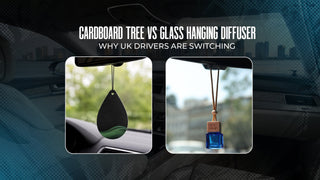
|
A glass hanging diffuser beats a cardboard air freshener on scent quality, adjustable strength, and looks, and costs roughly £0.75–£1.50 a week at £5.99. A cardboard tree is cheaper up front and needs no thought. Want control and a layered fragrance? Switch. Want a quick, cheap fix? Cardboard still works. But a hanging diffuser is best for use |
In This Guide
-
Cardboard Air Freshener vs Hanging Diffuser: The Quick Verdict
-
How a Cardboard Tree Air Freshener Works
-
How a Glass Hanging Diffuser Works
-
Head-to-Head: Six Differences That Matter
-
What Does Each Really Cost Per Week?
-
Why UK Drivers Are Switching
-
When a Cardboard Tree Still Makes Sense
-
How to Switch Without Wasting Money
-
Getting the Best From Your Hanging Diffuser
-
Which Hanging Diffuser Scent to Start With
-
Frequently Asked Questions
-
Conclusion
Cardboard Air Freshener vs Hanging Diffuser: The Quick Verdict
The cardboard air freshener vs hanging diffuser debate comes down to what you want from a car fragrance. A cardboard tree is a cheap, familiar disposable: you open the packet, hang it up and forget about it until the scent fades. A glass hanging diffuser is a slower, more considered product: fragrance oil in a glass bottle, released gradually through a natural wooden cap that you can loosen or tighten to set the strength.
Neither is wrong. They suit different drivers, and the table below shows where each one wins before we go into the detail.
|
Factor |
Cardboard tree |
Glass hanging diffuser |
|---|---|---|
|
Typical price |
£1–£2 per tree |
£5.99 per bottle |
|
Typical lifespan |
Often one to three weeks before the scent noticeably fades |
Around four to eight weeks, with the richest diffusion in the first month |
|
Fragrance character |
Usually a single, fixed-strength scent that is strongest when fresh |
A layered top-heart-base fragrance that evolves over time |
|
Strength control |
None; the card sets the strength |
Adjustable by loosening or tightening the wooden cap |
|
Look |
Functional; often something drivers would rather hide |
Designed to be seen on the mirror |
|
Care needed |
None |
Let it hang freely; avoid resting it against upholstery |
|
Best for |
The lowest up-front spend and zero fuss |
Control, a more refined scent and fewer replacements |
How a Cardboard Tree Air Freshener Works
A cardboard car air freshener is a piece of absorbent card soaked in fragrance oil and sealed in a wrapper. Once you open the wrapper and hang it up, the oil begins evaporating from the surface of the card straight away. There is nothing to adjust and nothing to maintain, which is exactly why it has been the default car freshener for so long.
What You Get for the Money
The appeal is obvious. A cardboard tree is inexpensive, easy to find and needs no explanation. You can pick one up on any errand, hang it in seconds and replace it without a second thought. For a driver who simply wants the car to smell of something other than the last takeaway, it does the job.
Where It Falls Short
The limitations come from the format itself. Because the oil is on the surface of the card, the release tends to be front-loaded: the scent is at its strongest in the first few days and then drops away. There is also no way to turn it down. In a small cabin with the windows shut, a fresh tree can be more intense than you would choose, and once it fades you are left with a car that smells of very little.
If strong fragrance tends to bother you, our guide to whether car air fresheners can trigger headaches or allergies explains why fixed-strength fresheners can be a problem and what to do about it.
How a Glass Hanging Diffuser Works
A hanging diffuser swaps the absorbent card for a small glass bottle of fragrance oil. A natural wooden cap sits in the neck of the bottle and acts as a wick: the oil is drawn slowly up through the wood and evaporates into the air of the cabin. Because the release depends on how much of the wood is exposed, the pace is steadier than a soaked card, and it is something you can change.
The Adjustable Cap
This is the single biggest practical difference. Keep the cap half-open for a gentle background scent, or open it fully for a richer throw. In an enclosed car that is parked overnight, closing the cap helps preserve the fragrance so it lasts longer. No cardboard freshener gives you that control, and it is particularly useful for anyone who finds a fixed-strength scent too much.
Materials and Look
A hanging diffuser is designed to be seen. The glass bottle and wooden cap hang from the rear-view mirror on a cord and read as a deliberate choice rather than an afterthought. That matters more than it sounds: plenty of drivers tuck a cardboard tree out of sight, whereas a diffuser is something you are happy to leave on show.
Browse the full Scentz Hanging Diffuser collection to see all five scents.
Head-to-Head: Six Differences That Matter
1. Fragrance Quality
Most cardboard fresheners lean on one dominant note. A well-made diffuser is built like a fine fragrance, with top, heart and base notes that reveal themselves over the weeks. In a car, where you smell the same thing every day, that evolution keeps the scent from feeling flat or stale.
We cover the difference in more detail in Luxury Car Air Fresheners UK: Are They Worth the Price?.
2. Longevity
A cardboard tree commonly needs replacing every week or two once the scent has faded. A hanging diffuser typically runs for four to eight weeks, depending on how far you open the cap and how warm the car gets. Fewer replacements also means fewer moments when your car has no scent at all.
3. Control
With cardboard, the strength is whatever the manufacturer decided. With a diffuser, you decide, and you can change your mind. That flexibility is the reason diffusers suit shared cars, sensitive noses and drivers who like a subtler background scent.
4. A Steadier Release
Because a cardboard freshener is front-loaded, the experience is a burst followed by a slow fade. The wooden cap gives a more continuous release, which sits between the burst of a spray and the quiet hum of a card. The richest diffusion comes in the first month, then gradually eases.
5. Appearance
This is subjective, but it is one of the most common reasons drivers upgrade. A glass bottle with a wooden cap looks like part of the interior. A printed cardboard shape usually does not.
6. Care and Placement
A diffuser asks for a little more thought. Let it hang freely rather than resting against upholstery or trim, because contact can leave marks and dulls the diffusion. Keep it upright, and hang it before you set off rather than as you arrive. Cardboard needs none of this, which is part of its charm.
What Does Each Really Cost Per Week?
It is easy to assume the cheaper product is always the better value, so here are the figures, using typical prices and lifespans rather than best-case ones.
|
Freshener |
Price |
Typical lifespan |
Approx. cost per week |
|---|---|---|---|
|
Cardboard tree |
£1–£2 |
1–3 weeks |
About £0.50–£2.00 |
|
Scentz Poly Card |
£2.99 |
3–4 weeks |
About £0.75–£1.00 |
|
Scentz Hanging Diffuser |
£5.99 |
4–8 weeks |
About £0.75–£1.50 |
The honest reading is that the ranges overlap. If a diffuser lasts the full eight weeks it works out at under 75p a week, comfortably cheaper than replacing a tree every fortnight. If it lasts four weeks with the cap fully open, it is closer to £1.50 a week. So the case for switching does not rest on price alone. It rests on getting a better scent, real control and fewer purchases for roughly the same weekly spend.
If you would like a lower-cost step up, the Poly Card collection starts at £2.99.
Why UK Drivers Are Switching
There is no single reason, but the move from cardboard to glass tends to come down to four things.
-
They want control. Being able to turn a scent up or down is a real upgrade over a fixed-strength card, particularly in a small car.
-
They want the scent to last. A freshener that fades within a fortnight becomes another job to remember.
-
They care how the car looks. The mirror is the most visible spot in the cabin, and a glass diffuser suits it in a way a cardboard shape does not.
-
They want a fragrance they actually like. A layered scent inspired by a place, such as a crisp London citrus or a refined Milan blend, feels more personal than a generic novelty scent.
When a Cardboard Tree Still Makes Sense
A fair comparison has to include the cases where cardboard wins. It still makes sense if you are on a very tight budget, if you are fitting a freshener to a car you are about to sell, or if you simply want something disposable with no decisions attached. It is also a reasonable choice for a temporary fix, such as a hire car for a weekend.
If you would like something in between, a slim card gives you a step up in scent quality without the extra outlay of a bottle.
How to Switch Without Wasting Money
Moving from cardboard to a diffuser does not need to be a big commitment. A sensible approach looks like this:
-
Finish your current tree. There is no need to bin something that still works.
-
Pick one scent you are drawn to. Choose the description that appeals rather than trying to guess your favourite.
-
Start with the cap half-open. It is easier to open it further than to live with a scent that is too strong.
-
Give it a week. Fragrance takes a few days to settle, and your nose adapts, so judge it after a few drives rather than the first.
-
Adjust to taste. Loosen the cap for more scent, tighten it for less, and close it when the car is parked and enclosed for long periods.
Getting the Best From Your Hanging Diffuser
A few habits make the biggest difference to how long the diffuser lasts and how it performs:
-
Unbox it carefully. Twist off the cap, peel away the protective seal, then replace the cap to start the fragrance.
-
Hang it where it can swing. Loop the cord around the rear-view mirror and keep the bottle clear of upholstery and trim.
-
Hang it before you leave. That gives the fragrance a few minutes to settle so the car smells right as you get in.
-
Use one per car. A single diffuser is designed to give a balanced fragrance in a typical car cabin without overwhelming it.
-
Mind the heat. Warmth speeds up evaporation, so a car left in the sun will use the fragrance more quickly.
Which Hanging Diffuser Scent to Start With
All five destination scents come in the hanging diffuser format at £5.99. If you are switching from a generic cardboard scent, these are the quickest ways to choose:
-
Milan Spirit: refined citrus and vetiver, understated and easy to live with.
-
London Flair: crisp pear and freesia, clean and everyday.
-
Dubai Nights: warm, opulent oud and vanilla for a richer, evening feel.
-
Rio Carnival: vibrant tropical bergamot, bright and energetic.
-
Tokyo Dreams: delicate florals and cedarwood, soft and light.
Shop each one directly: Milan Spirit · London Flair · Dubai Nights · Rio Carnival · Tokyo Dreams
Want the full story behind our most understated scent? Read Milan Spirit: Inside Our Italian Citrus & Spice Car Fragrance.
Frequently Asked Questions
Is a hanging diffuser better than a cardboard air freshener?
For most drivers who want control and a more refined scent, yes. A hanging diffuser lasts roughly four to eight weeks, lets you adjust strength with the cap, and uses a layered fragrance. A cardboard tree is cheaper up front and needs no thought, so it still suits anyone who only wants a quick, inexpensive fix.
How long does a glass hanging diffuser last compared with a cardboard tree?
A Scentz hanging diffuser typically lasts four to eight weeks, with the richest diffusion in the first month. A cardboard tree often fades noticeably within one to three weeks. Heat and how far you open the cap both affect the pace, so a warm car will use the fragrance faster than a cool one.
Is a hanging diffuser cheaper than cardboard in the long run?
It can be, but not always. At £5.99 lasting eight weeks, a diffuser costs under 75p a week, which beats replacing a £1–£2 tree every fortnight. At four weeks it is closer to £1.50 a week. The real advantage is better scent quality and control for a similar weekly spend.
Can a hanging diffuser damage my car's interior?
It should not if used as intended. Let the bottle hang freely from the mirror rather than resting against upholstery, trim or walls, because contact can leave marks and muffles the fragrance. Keep it upright and clear of surfaces, and you avoid the main risk with any hanging freshener.
How do I make a hanging diffuser weaker or stronger?
Use the wooden cap. Loosening it lets more fragrance oil travel up the wood, giving a stronger scent. Tightening it slows the release for something subtler. Keeping the cap half-open suits most cars, and closing it while the car is parked and enclosed helps the fragrance last longer.
Should I use more than one hanging diffuser in the same car?
Usually not. One diffuser is designed to give a balanced fragrance in a typical car cabin, and adding a second tends to make the scent stronger rather than better. If you want more presence, open the cap a little further instead of adding another bottle.
Conclusion
A cardboard tree and a glass hanging diffuser both make a car smell better, but they are not the same kind of product. Cardboard is cheap, disposable and effortless. A diffuser costs a little more upfront, then gives you a layered fragrance, adjustable strength and a look you are happy to leave on the mirror. Because the weekly cost is broadly similar once you count replacements, the switch is really about what you want from the scent, not about saving money.
If you are ready to move on from the tree, start with one scent, keep the cap half-open and adjust from there.
Explore the Scentz Hanging Diffuser collection, or browse
the full Scentz range to compare every format and scent side by side.